Saint John Energy exemplifies how modernizing the distribution grid can be a productive path for greater affordability and resiliency. In a recent episode of GridPulse, the Grid Forward podcast, CEO Ryan Mitchell shared how Saint John Energy has using a range of hardware and software innovations — such as renting high-effiiciency heating and deploying advanced demand management — to meet growing customer demand with the lowest rates in the region. He also discussed their new Plugin Labs, a digital twin of system data designed to give innovators and developers a safe environment to test new ideas before launching software solutions.
Following is an excerpt of his conversation around their affordability focus with Grid Forward Executive Director and CEO Bryce Yonker. You can listen in to the entire discussion on this website or popular podcast apps.
Ryan Mitchell: We are a 100 year old utility that I think I can say has decided not to act our age. We are a community-owned, purely electric utility serving Saint John, New Brunswick, so up in Canada. And Saint John is Canada’s oldest incorporated city. We happen to be home to the country’s largest oil refinery and one of the country’s major ports.
Although we are a distribution utility, we are a bit unique in that we do more than operate poles, wires and substations. We also retail electricity, and we set our own rates. And we do work directly with customers behind the meter through things like heat pump and water heater rentals, EV chargers and other electrification services. To put our size into perspective, we do distribute about one terawatt hour of electricity each year. We are very much a winter peaking utility, and I would say that we’re probably best known for the reliability of our system, our focus on affordability and for being innovative.
QUESTION: What are some of the challenges and the drivers that are priorities for you all there in the system that you run?
I’ll share a little bit about our cost structure, because I think that will help inform why we’re focusing on some of the things that we are focusing on. We are a wholesale customer of the provincial utility. And our monthly energy bill is comprised of two components: an energy component and a demand component. The energy amount is approximately $95 Canadian a megawatt hour, and the demand component is quite punitive at $20,000 per megawatt for whatever high water mark that we set and hold for at least 15 minutes each month. So the demand or peak energy, it’s very expensive for us. It makes up about 30% of our annual budget.
And there’s not only a financial incentive, but there’s also an environmental incentive with that, because peak energy often equates two times the greenhouse gas emissions as off-peak electricity generation. So we’re very active in terms of looking at how we can drive efficiencies and cost savings through the addition of renewable energy, and by reducing peak demand through innovative approaches.
We are a winter peaking utility because most of the homes in our region are heated by electricity. On peak days, it generally correlates very tightly with the colder temperatures. And the majority of domestic hot water is also heated by electricity. So often peaks are in the morning as people are getting up, grabbing a shower before heading to work or to school. So we spend a lot of time looking at how we can decrease the supply cost of energy and as well how we can reduce those peak charges.
QUESTION: Affordability is Grid Forward’s central focus for our main event this year. There are so many drivers impacting delivered prices of electricity right now. How are you able to keep such competitive rates?
Our residential rates do remain among the lowest in our region. They’re about 25% less than the rest of Atlantic Canada on average, and about 14% less than the national average. In dollars and cents, our residential rate is just under $0.14 Canadian, about $0.10 in US dollars per kilowatt hour.
There’s really two main areas that we focus on that have allowed us to maintain those low rates. I mentioned our focus on renewable energy. So we have, over the last couple of years, added about 15% of our supply through distribution, connected wind energy. It has reduced emissions, but it also has avoided millions of dollars in energy costs.
We’re also very focused on demand response. We have improved our load factor by approximately 7% since 2020. And there’s really a few main things that have contributed to that. One of the most significant is voltage conservation and reduction. The majority of our power transformers are equipped with tap changers. So we do fluctuate the voltage up and down depending on the overall load on our system, and that has proven to be very effective, especially where we have relatively short feeder lengths.
We also have been doing some work over the last few years with utility scale storage. We were actually the first in the world to deploy Tesla Megapack batteries in 2019, and we have just over seven megawatts on our system today.
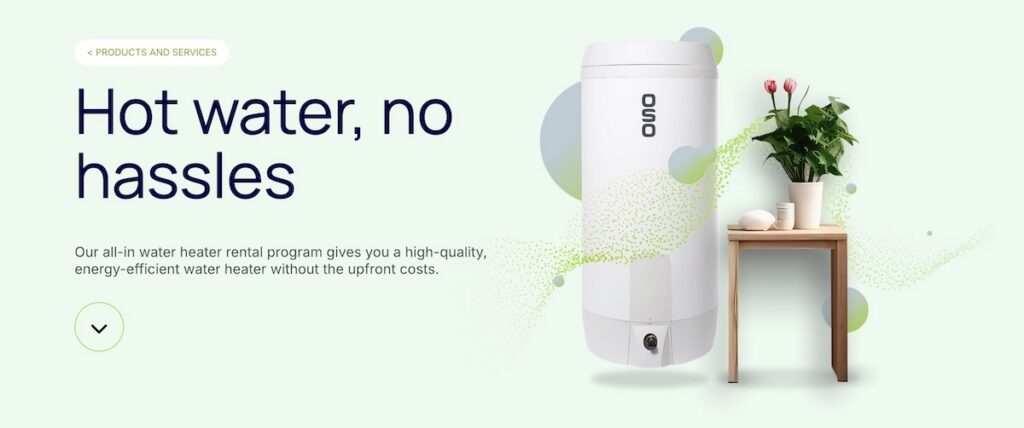
Also, we rent water heaters, about 25,000 water heaters that we own and rent to our customers today. We have been implementing controllers on those water heaters again, to be able to influence, the demand or the draw that they would be having on our system.
Because of the success that we’ve had with renewable energy and the innovation around demand response, we have been able to absorb some of the rate increases from the provincial utility on us as a wholesale customer. We’ve been able to save our customer from a few percentage point increases over the last couple of years. Then last year, we waived the monthly system connect fee for our customers, which equated to like issuing a $25 dividend to each of our customers.
But quite simply, I would say we’re trying really hard to prove that the cleanest and the most modern grid can also be the most affordable grid.
QUESTION: You mentioned adding renewables into the supply side of the equation there. You have a substantial target for additional resources that you’re trying to bring in. Talk a little bit about that campaign and the roadmap that you have ahead.
A few years back, we did receive some funding from the federal government to embark on an initiative that we named as Zero30: how might we reach a net-zero electricity system by the year 2030. So very aggressive, some would say impossible. It was really intended to challenge ourselves, like what would it actually take to get there? What would we have to do?
There were three primary areas within Zero30 that we focused on. The first one was cleaning the supply of electricity. The second one was all around electrification. So working with our customers, what programs and supports and services would our customers like to see us bring to the market to help them get off of fossil fuels and move to electricity. The third was planning for grid expansion. As more customers electrify their lives, what parts of the grid are going to require upgrades. So those were the three primary areas. The roadmap phase is recently completed and we’re now active in execution.
QUESTION: Let’s dive into some of the components. You had mentioned significant resources to leverage flexible resources: renting hot water heaters to your customers, the early days of energy storage. What are you achieving with them?
I’ll start with respect to the customer and the behind-the-meter side. Up to 70% of our customers would rent at least one product from us. It started with water heaters, and it has more recently expanded into renting heat pumps. Heat pumps are about four times more efficient than electric baseboards. So that has been a very successful program. These have really allowed us to create a trusting relationship with the customers and as well has allowed us to remove some of the upfront cost of electrification by offering rental program as opposed to like an outright sale. Those assets offer a lot of value to supporting the grid.
As an example, water heaters represent a very interesting and significant flexible resource. The water heaters that we have deployed have a 4-kW element, and we have 25,000 of them. So from a nameplate perspective that equates to approximately 100 MW of controllable load. A water heater isn’t an electric battery though obviously. It’s a thermal battery, and it’s an asset that we already own. So how can we make most efficient use of it? How can we shift some of the times when it’s being used without affecting hot water availability? And as a result reduce peak demand and lower system costs?
Listen in for more details of how Saint John Energy is modernizing its grid to improve reliability and affordability. You’ll find GridPulse on this website as well as your favorite podcast app.