Insights gained at the symposium Standing Up to Wildfire: Practical Tech and Tactics for Utilities
By Linda Barney, Barney and Associates
On June 4, 2025, Grid Forward hosted a Symposium ‘Standing up to Wildfire: Practical Tech and Tactics for Utilities’ in Portland, Oregon. Bryce Yonker (Executive Director & CEO) introduced the event and Plenary, Panel and group huddle sessions were held throughout the day. This event provided insight into how groups can work together to make grid infrastructure and communities safer and more resilient by mitigating catastrophic wildfire risk. The Symposium included attendees from firefighting organizations, utilities, energy regulators, federal officers, and vendors. I was privileged to attend the Symposium and sit in on plenary, panel sessions and two huddle discussions throughout the day and this article provides my perspective on the productive event.
This is part 1 of a 3-part article shared with Grid Forward members after the event.
Not all fire is bad…
Dave Winnacker, retired Fire Chief and Policy Advisor for the Western Fire Chiefs Association, opened the Symposium by offering his perspective as a fire chief on challenges and solutions for wildfire mitigation in the energy sector. Fire Chief Dave Winnacker has been in the fire service for 19 years in Fresno City, Alameda County, and the Moraga-Orinda Fire District. Winnacker indicated that not all fire is bad, there can be beneficial fire with low intensity and lower ability to burn to control overgrowth of vegetation. But high winds and dry vegetation results in catastrophic wildfires that have more vegetation than firefighters can handle. “We cannot exclude wildfire from the landscape, but we can limit wildfire losses to our communities. Passive, durable, pre-fire mitigations are a requirement to control these outcomes,” stated Winnacker.
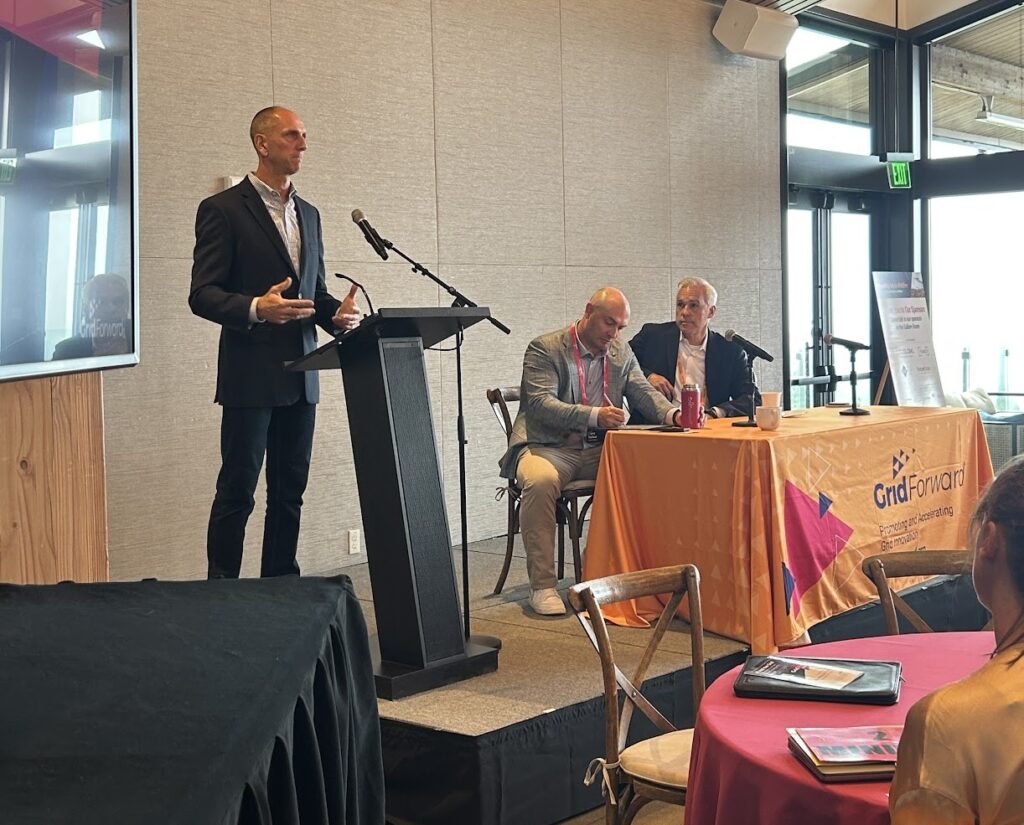
Dave WInnacker addresses the Wildfire Symposium, with Bryce Yonker (Grid Forward) and Bryan Hannegan (Holy Cross Energy).
Bryan Hannegan, President and CEO, Holy Cross Energy, located two hours west of Denver, Colorado was the next speaker in the opening Plenary. Holy Cross Energy experienced three major wildfires since 2017—none of which were started by their utility. Holy Cross Utility takes wildfire planning and mitigation seriously. Hannegan indicated, “We won’t be able to reduce utility wildfire risk down to zero, so we will need to take collective mitigation actions.”
What utilities can do to reduce the risk of starting a wildfire
Speakers on panels mentioned that when you think of wildfire danger, attention usually focuses on the US western states. However, wildfires occur across the country. In addition, wildfires increasingly occur in unexpected areas or at unexpected times such as winter. This makes wildfire mitigation critical and is a top priority for utilities and fire response agencies.
Speakers stressed the importance of wildfire mitigation across these areas: situational awareness, vegetation management, system hardening, operational management and maintenance, and
Enhanced Powerline Safety Settings (EPSS) and Public Safety Power Shutoff Safety (PSPS) planning. The creation of a Wildfire Mitigation Plan is now essentially required along with post-analysis of wildfire mitigation to determine how it to compared to the plan. Communication with firefighters, other utilities, and communities is critical in wildfire mitigation and in helping community members understand that they need to be involved in areas such as vegetation management to help reduce catastrophic wildfire risk.
Situational awareness, data collection and analysis
Vegetation management is just one tool in the toolbox for utilities to help reduce the risk for starting a fire.
- Vegetation management: Vegetation is one of the greatest contributors to power outages and wildfires caused on the electric grid. Utilities use vegetation management to remove vegetation near power poles or bird nests that may be vulnerable to a spark resulting in a wildfire. In addition to having crews manually patrol their territories, utilities are using tools such as drones and cameras overlooking sites, satellite, LIDAR, and other imaging capabilities.
- System hardening: Speakers and attendees described various utility system hardening changes they are making as part of the wildfire mitigation improvements. Burying power lines underground is typically too expensive for wide deployments and is a long-term strategy. Short term hardening includes changes such as old copper wire replacement, sensors, smart electronic reclosers, fuses, covered conductors, larger wires, and transitioning wood poles to steel and other fire-resistant materials.
- EPSS and PSPS planning: EPSS advanced safety settings allow powerlines in high-risk areas to
automatically turn off power within one-tenth of a second. This can happen when there’s a hazard, like a tree branch falling into a powerline, which can cause a fire. During extreme weather events, electrical power in high fire-threat areas may require that power be shut off using a Public Safety Power Shutoff (PSPS) shutoff. It is essential to prepare for a PSPS event and have a plan. Utilities are encouraged to work with firefighters and other agencies on PSPS Plans and how to implement them. - Operational management and maintenance: Wildfire operational management and maintenance
encompasses a wide range of activities focused on preventing, detecting, and making changes to help reduce wildfire risk. Attendees stressed that it is important to use data to make operational
management decisions and effective maintenance of utility infrastructure is critical. This is no small feat: The Director of the Pacific Gas & Electric Company (PG&E) Wildfire Mitigation team indicated
that PG&E needs to monitor tens of thousands of poles, deploying thousands of monitoring devices to help identify issues before they become possible ignitions. This can include such straightforward tasks as removing avian nests, which are a major source of transmission ignitions.
Tools used to improve situational awareness
Like PG&E, many utilities are using a wide variety of hardware devices, web apps and AI tools along with drones to provide situational awareness data, track utility equipment issues and locate information on wildfires. Here are some of the tools that were openly discussed at the Symposium.
- Gridware high-definition camera and sensors: PG&E is using Gridscope sensors developed by Gridware to improve situational intelligence on EPSS circuits on power poles and mid-span of powerlines. Since initial deployment in 2023, the PG&E solution has enabled PG&E teams to intervene in over a dozen situations including identifying damage and mitigating potential
ignitions in certain cases. - Esri: ArcGIS software provides geographic information system (GIS) technology manages, analyzes, and maps all types of energy utility data for modern network management. ESRI’s Survey 1, 2, and 3 solution provides information such as downed trees on powerlines and can provide alerts to appropriate firefighting or utility personnel.
- Overstory: Holy Cross Energy, Puget Sound Energy and the Clark County PUD are using Overstory AIpowered vegetation intelligence software to help handle proactive vegetation management.
- Watch Duty: Watch Duty is a free mobile application that provides a map with real-time wildfire information. It utilizes a combination of official data sources and human monitoring by experienced
volunteers, including active and retired firefighters, dispatchers, and first responders.
Hot new technology: AI, Automation and Predictive Analytics for wildfire mitigation
The next session I participated in continued the discussion of mitigation technology, with a special
focus on how AI helps aid in wildfire mitigation. This session featured two vendors with AI-based platforms used for vegetation management and fire awareness to aid in wildfire risk reduction.
Artificial intelligence (AI) software by SharperShape aids utilities in vegetation management. The Senior Director of Marketing and Development at SharperShape described how the tool creates a Living Digital Twin which is a digital replica of a utilities area and vegetation. A digital image is initially captured
using drones or a helicopter to take photos looking for vegetation encroachment issues such as tree fall strike zones or branches overhanging on wires. The utility map is dynamic and can be easily updated with drone inspections. Humans need to train the AI software to meet their specific needs using prioritizing functions built in to help determine the areas that are needed to focus on first, and then create a more detailed forecast to define areas with vegetation risk.
Pano AI is a Wildfire Detection and Situational Awareness solution that enables faster, collaborative wildfire response efforts to help keep communities, property, and the environment safe. The leader of the North America sales organization at Pano AI indicated their solution includes two ultra-high-definition cameras mounted on the top of cell phone towers and at other overlooking locations. Pano’s cloud-based AI system monitors for smoke 24/7, backed by Pano Intelligence Center Detection that is supplemented with additional third-party sources, including satellite, emergency services, third-party GIS data, and customer-provided feeds. Once smoke is detected, an alert and location notification is sent to utility or firefighter staff. Smoke was even detected and an alert sent to critical area
organizations in view of the venue location during the meeting
Watch for parts 2 and 3 of this article coming to the Grid Forward blog soon.