
By Bryce Yonker, Executive Director and CEO, Grid Forward
I joined thousands of other utility and grid folks at DTECH 2026 in San Diego last week.
No doubt, there are promising and important things happening in and around the tech ecosystem of the grid. But the industry’s bigger currents and stronger winds were really neither talked much about or seen in any of the surface level posts after the event. After reading a bunch of vanilla post recaps and thinking around the dozens and dozens of conversations I had there, I felt a spark to post something honest.
The last 18 months or so have opened up the possibility for a renaissance in grid infrastructure. The explosion of the potential of AI demand and the related compute requirements are indeed at the front. Combined with electrified transportation, industrial expansion, and the steady growth of anything we rely on in commercial and residential life centering around the demand for supply of electricity, we find ourselves at an opportunity not seen in at least four to five decades. There is as strong a need for energy and the grid as ever. The industry for the most part was not ready and is not now capturing this moment.
I was listening this week to the nearly three-hour podcast with Elon Musk (listen/watch for yourself here). A large part of about the episode concerned the constraints for the ventures he is pioneering. And at the top of his list is energy and the grid. He is not seeing near-term progress from the grid to power AI, compute and other rapidly expanding frontiers. His conclusion was that in the next three to five years it will be easier to launch datacenters into space. Let’s let that sink in a bit. The global infrastructure ecosystem providers are taking so long in their deployment (with the possible exception of China) that Elon thinks it will be better to scale AI infrastructure in space.
Should the utility and grid community do all the necessary work to ensure investments are prudent and useful? Absolutely. Balancing and justifying the investments being made now are their biggest challenges in decades. But how have we become so calcified in our ways that pioneers think getting power in space is the easier solution than expanding and making our grid capable for their buildout?
We must do better. It’s time.
It’s time for the electric grid industry (utilities and all stakeholders working around it) to be capable of doing big things again. The last time we did, in the middle part of the 20th century we built an impressive infrastructure that is the basis of modern, electrified and now digital society that we live in.
It’s time for us to stop working on things around the edges and get straight to the core. We have many of the tools ready (I would argue nearly all) in the kit but we need to deploy them at scales that really matter. I’m talking here about the basics – more generation, more transmission, more distribution. I’m also talking here about the advanced forms of running the grid at all stages – more real time awareness, more automated controls, much more flexibility.
It’s time for us to shift models and strategies so we can set a foundation for our future. Regulatory structures have provided necessary and useful guardrails over the last century but we need to evolve them to allow for the incentivization (if not encouragement) of meeting the moment we are in.
It’s time to spend on actual solutions. We are investing much of our resources on Band-Aids. We need more systemic treatment. Today’s solutions are often one-off, separate and not connected. We need the parts to come together wholistically.
To do this we can’t do it separately. Too often, innovators, operators, investors, government and advocates approach the issue like the blind men and the elephant in the ancient Indian parable, each certain in their viewpoint and suspicious of others. Many of the lines have been drawn and positions solidified. We need to be working together. In our evermore balkanized society this will not be easy, but we cannot accept a society with the energy and grid ‘haves’ and the ‘have nots’. We all pay for the capabilities of the grid – directly in our rates and indirectly in the quality of the service it provides. The sooner we realize that we are in this together, and all need to invest in it together, the better a chance we have of all benefitting from a capable grid.
Elon ended his long conversation this week that he chooses to be optimistic for the future. I choose the same. The natural trajectory of where we are going right now will not lead to a grid that will meet the needs of the day, nor the days ahead. I know, however, there are many passionate and capable people in this industry — many of them I got to see again or meet at DTECH. Working together we can do this, but its time that we step up and get ready to do great things (again).
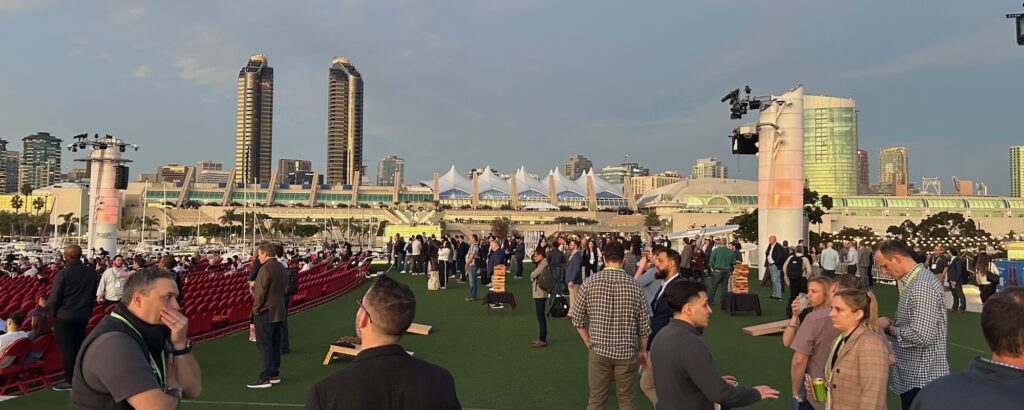
DTECH 2026 outside the San Diego Convention Center. Credit: Grid Forward
Post feature image: DTECH 2026 entrance. Credit: DTECH