Traditional net‑metering models are often difficult to apply in a multi-family setting. Grid Forward member Idaho Falls Power (IFP) sought to test innovative customer‑sited distributed energy resources (DERs) through its first multi‑family Net Metering Pilot Project with Orchard Park Energy LLC.
Orchard Park Apartments, located in Idaho Falls, Idaho, is a new multi-family residential development with rooftop solar generation and behind-the-meter battery storage capabilities. Through a Power Sales Agreement with IFP, Orchard Park can now export excess energy back to the utility under a controlled pilot program. Net-metering will be applied to the aggregated meter totals for the project, rather than individual meters. The project provides insight into time‑of‑day impacts, system peak shaping, billing effects, and DER data‑sharing, all while supporting customer sustainability goals.
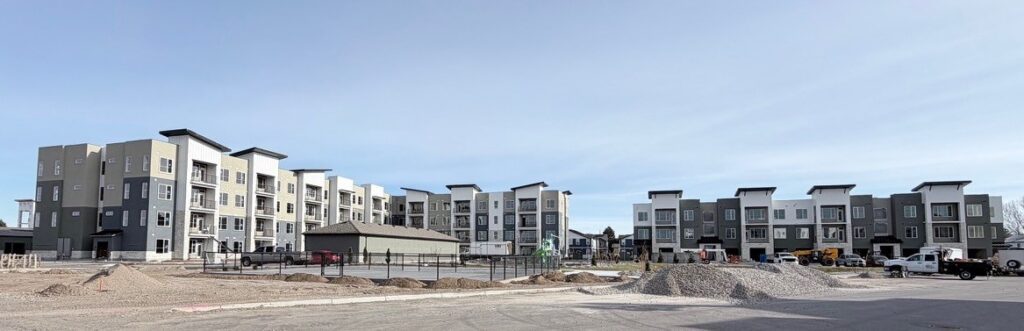
IFP’s agreement with Orchard Park Energy LLC implements bi‑directional metering, a new Net Energy billing structure, wholistic project metering aggregation, and required data‑sharing to support system modeling. It provides a replicable framework for future DER‑enabled developments and expands IFP’s real‑world experience with solar + storage integration in residential applications.
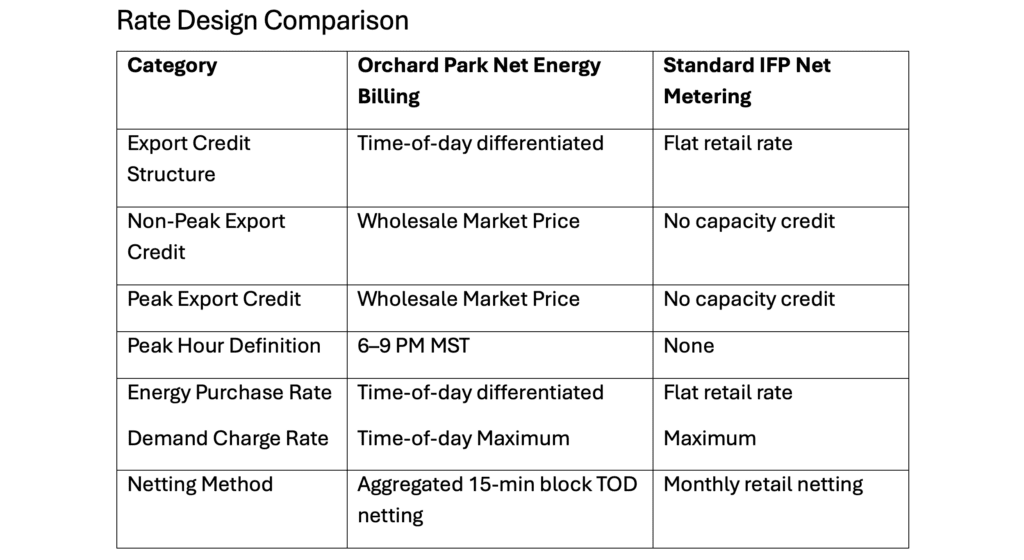
Pilot rate structure (Net Energy Billing)
Under the pilot, Orchard Park Energy LLC is compensated for exported Net Energy based on time‑of‑day rates established in the Power Sales Agreement:
- Peak Hours: 6:00 PM–9:00 PM MST (three hours once per day)
- Non‑Peak Hours: All other hours
- Credit rates for exported energy:
- Non‑Peak Hour exports: Wholesale Market Price for the Mid-Columbia hub
- Peak Hour exports: Wholesale Market Price for the Mid-Columbia hub
- Retail energy purchase rate from IFP: peak Hours: $0.086 / kWh; non-Peak Hours: $0.037 / kWh
Billing is based on IFP’s monthly metered Net Energy calculation, which subtracts energy delivered by the Customer from the energy purchased from IFP during the same billing period. Customers receive credit only; no direct payments are made.
Pilot organization and insights
Orchard Park bears all costs associated with installing and maintaining solar, battery, and onsite electrical infrastructure. IFP provides the bi‑directional metering equipment and administrative oversight. Additional cost considerations include future billing system adoption, engineering review, and potential program expansion based on pilot outcomes.
The pilot delivers a structured, time‑of‑day net‑metering model that implements a new aggregated virtual metering billing structure and improves visibility into customer production and usage patterns. It also enhances operational data collection, enabling IFP to evaluate DER impacts on distribution circuits and peak load alignment. The program strengthens IFP’s ability to develop future policies for multi‑family DER participation and will inform long‑term rate design, grid planning, and customer program development.
Project timeline
The pilot project kicked off with an agreement executed September 12, 2024, with a 10-year initial term and automatic renewal options. The pilot is active upon installation and commissioning of solar + battery systems at Orchard Park Apartments.
Upon activation of the solar + storage system, IFP will perform ongoing monitoring of production, export profiles, and system loading impacts. Staff will evaluate the success of the time‑of‑day aggregated Net Energy billing structure and assess whether the pilot should be expanded to other multi‑family developments. IFP will incorporate findings into future rate evaluations, DER integration planning, and potential policy recommendations to the City Council.